

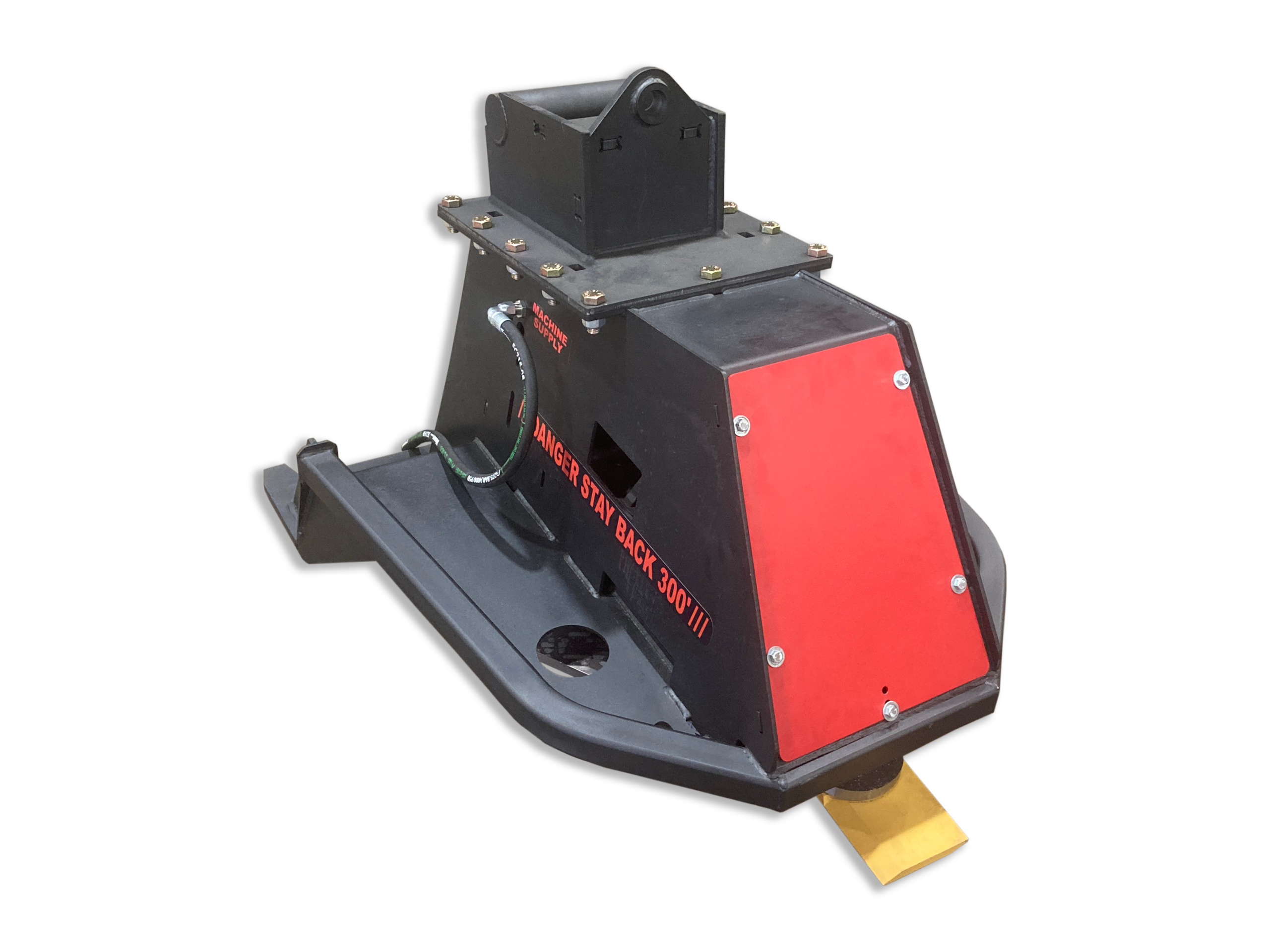
When comparing an excavator brush cutter vs disc mulcher, the right choice comes down to what you need to clear, the conditions you’re working in, and what your excavator can handle. Both attachments can turn an excavator into a powerful vegetation-management machine, but they aren’t designed for exactly the same jobs. At Rut Manufacturing, we help equipment owners match their machines with attachments built for the work they actually need to accomplish. If you’re unsure which option fits your excavator and application, call us at 336-859-0328, and we’ll help you narrow it down.
An excavator brush cutter is designed to tackle vegetation while taking advantage of an excavator’s reach and maneuverability. Instead of bringing the machine directly over every area that needs to be cleared, operators can reach into ditches, along slopes, around obstacles, and into other difficult areas.
A brush cutter for excavator applications can be a strong choice for property maintenance, right-of-way work, overgrown areas, and general vegetation control. Depending on the specific attachment, these cutters can handle everything from grass and weeds to brush and woody growth.
The biggest advantage is versatility. If your jobs primarily involve maintaining vegetation and cutting brush rather than processing larger trees and dense woody material, a brush cutter may give you the performance you need without moving into a more aggressive mulching attachment.
An excavator disc mulcher is built for more aggressive vegetation management and land-clearing applications. Rather than simply cutting vegetation down, a disc mulcher is designed to attack and process woody material.
A disc mulcher for excavator use can be particularly valuable when jobs involve dense brush, saplings, trees, and other substantial growth. The combination of an excavator’s reach and an aggressive cutting attachment allows operators to work through areas where access may otherwise be challenging.
Disc mulchers are especially useful when the goal extends beyond routine vegetation maintenance and into heavier land clearing.
Although both attachments can play an important role in vegetation management, choosing between them requires looking closely at the type of work you’ll be doing most often.
Start with the material you expect to encounter.
Brush cutters are generally well suited for routine vegetation management, including grass, weeds, brush, and other overgrowth within the rated capabilities of the specific attachment. They can be an effective option for maintaining properties, clearing rights-of-way, working around ponds and ditches, and controlling recurring growth.
Disc mulchers are geared toward more demanding clearing jobs where heavier woody vegetation is the primary concern. If you’re routinely dealing with dense growth, saplings, and trees, the additional processing capabilities of a disc mulcher may make it a better fit.
Before choosing either attachment, always check the rated cutting capacity of the specific model rather than assuming all brush cutters or disc mulchers can handle the same material.
Performance isn’t simply about which attachment is more powerful. It’s about matching that performance to the job.
A brush cutter can provide an efficient way to move through lighter and moderate vegetation without using an attachment designed for heavier work than the application requires.
A disc mulcher brings a more aggressive approach to woody material. That can make it valuable for land-clearing jobs where efficiently cutting and processing substantial vegetation is the priority.
The best attachment is the one that lets your excavator work productively without unnecessarily exceeding the needs of your typical jobs.
It’s also important to think about what you want the property to look like when the job is complete.
A brush cutter is primarily focused on cutting vegetation and knocking down unwanted growth. That can make it well suited for maintenance-oriented projects where the main objective is opening an area or controlling vegetation.
A disc mulcher is designed to more aggressively process woody material. For projects where reducing trees, saplings, and brush is an important part of the desired result, its cutting style can offer an advantage.
One reason excavator attachments are so useful for vegetation management is the machine’s ability to reach areas that may be difficult for other equipment to access.
Depending on the machine and attachment, operators may be able to work along slopes, banks, ditches, fence lines, wooded areas, and around obstacles without positioning the entire machine directly over the vegetation.
When comparing attachments, consider not only what you’re cutting but also where you’re cutting it. Terrain, accessibility, vegetation density, and the amount of reach required can all influence which option makes the most sense.
Hydraulic compatibility is one of the most important factors when choosing excavator land clearing attachments. Flow, pressure, machine size, and the specific attachment model all need to be considered together.
Our compatibility data shows why it’s important to look at the exact machine rather than assuming that every excavator can operate the same cutter.
For example, the Bobcat E35 has an auxiliary standard flow of 16.9 GPM and auxiliary pressure of 2,987 PSI. Our compatibility guide pairs that machine with the 28-inch Disc Mulcher and 36-inch Brush Cutter Tree Slayer. Step up to the Bobcat E60, which provides 20 GPM of auxiliary standard flow at 3,045 PSI, and compatible options expand to 36- and 42-inch Disc Mulchers as well as 36- and 42-inch Tree Slayers.
The same principle applies across manufacturers. For example, our guide pairs the Kubota U35-4, which has a standard hydraulic flow of 15.8 GPM, with a 28-inch Disc Mulcher and 36-inch Tree Slayer. The larger Kubota KX080-5 has a maximum hydraulic flow of 26.4 GPM and is paired with a 42-inch Disc Mulcher or a 42- or 48-inch Tree Slayer.
These examples demonstrate why hydraulic flow is important, but it isn’t the only specification that determines compatibility. Machine size, weight, pressure, attachment size, and other machine-specific considerations can affect the correct pairing.
Before selecting an attachment, we recommend checking the specifications and compatibility information for your exact machine. Matching the cutter to the carrier is an important part of getting the performance you expect from your equipment.
When customers ask us about the best excavator attachment for clearing brush, there isn’t one answer that applies to every job.
An excavator brush cutter may make the most sense when:
A disc mulcher may be the better choice when:
Your decision should ultimately come down to the vegetation, terrain, machine capabilities, and results you need to achieve.
If you’re still deciding between a brush cutter vs. a mulcher, comparing the two based on your most common applications can make the decision easier.
| Factor | Excavator Brush Cutter | Excavator Disc Mulcher |
| Grass and lighter vegetation | Well suited | More attachment than many light-clearing jobs require |
| Brush management | Well suited, within rated capacity | Well suited for demanding growth |
| Dense woody material | Depends on attachment capacity | Designed for more aggressive applications |
| Trees | Depends on attachment and rated capacity | Better suited to heavier woody material |
| Routine property maintenance | Strong option | Better when heavier clearing is regularly required |
| Aggressive land clearing | Application dependent | Strong option |
| Hydraulic requirements | Must match machine and attachment | Must match machine and attachment |
| Primary advantage | Versatile vegetation management | Aggressive cutting and processing |
No comparison table can replace checking the specifications for your exact machine and attachment. Rated cutting capacities, hydraulic requirements, and compatibility should always be reviewed before making a final decision.
The attachment you choose can directly affect productivity on the job. Before making a decision, we recommend asking a few practical questions:
Machine size also matters. A smaller excavator may be compatible with a smaller cutter, while a larger machine can support different attachment options. But a larger excavator doesn’t automatically mean every Rut attachment will work.
For example, our compatibility data lists both the Disc Mulcher and Tree Slayer as not compatible with certain larger machines. That’s why we recommend starting with the exact make and model of your excavator rather than choosing an attachment based only on horsepower, hydraulic flow, or cutting width.
Answering these questions can help determine whether you need the versatility of a brush cutter or the more aggressive capabilities of a disc mulcher while also identifying the appropriate model for your carrier.
At Rut Manufacturing, we understand that an attachment is only useful when it performs reliably on the machine and job it was selected for. That’s why we focus on helping customers find equipment suited to their specific applications rather than treating attachments as one-size-fits-all products.
We’re a veteran-owned, family-owned manufacturer, and we take pride in building high-quality attachments for demanding work. Our approach centers on durability, performance, and helping our customers get more productivity from the equipment they already own.
When you choose Rut Manufacturing, you benefit from:
Whether you’re maintaining overgrown property or taking on demanding land-clearing projects, our goal is to help you find an attachment that allows your machine to work efficiently and effectively.
Choosing between an excavator brush cutter vs disc mulcher starts with understanding both your work and your machine. If you’re primarily maintaining vegetation and clearing brush, a brush cutter may offer the versatility you need. If your jobs regularly involve dense woody growth, trees, and more aggressive clearing, a disc mulcher may be the better option.
Just as importantly, don’t assume an attachment will fit your excavator based on machine size alone. Hydraulic flow and pressure, operating weight, attachment size, and the specific make and model can all affect compatibility. Our machine compatibility data helps identify which Rut attachments and sizes are appropriate for individual machines so you can make a more informed decision.
We’re here to help you sort through those considerations. Call Rut Manufacturing at 336-859-0328 to tell us about your excavator and the work you’re tackling, and we’ll help you find the right attachment for the job.
Follow us on Facebook and Instagram for more information and industry updates.