
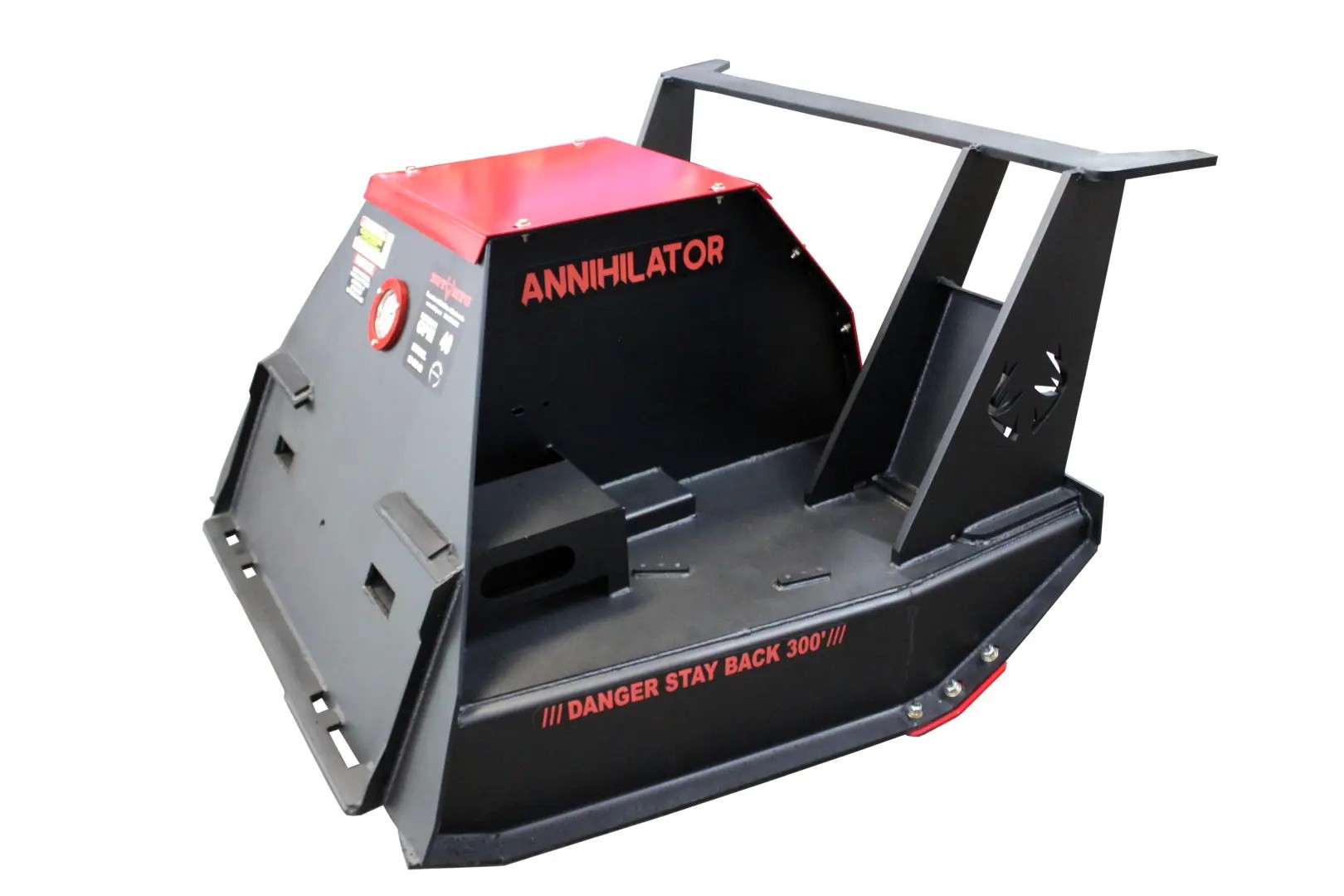
Choosing the best machines for forestry mulching starts with understanding the work you need to accomplish and how your equipment will handle it. Skid steers and excavators can both be excellent carriers for forestry mulching equipment, but factors such as hydraulic capabilities, machine size, terrain, vegetation, and attachment compatibility can make one option better suited for a particular job. At Rut Manufacturing, we build high-performance attachments for demanding land-clearing applications and help our customers find equipment that pairs properly with their machines.
If you’re unsure which attachment is right for your skid steer or excavator, call us at 336-859-0328. We can help you evaluate your machine and find an attachment suited to the work you need to tackle.
Forestry mulching puts significant demands on both the machine and the attachment. Choosing the right carrier isn’t simply a matter of finding the biggest or most powerful machine available. The entire setup needs to work together.
Some of the most important factors we recommend considering include:
The goal is to create a combination that gives the attachment the power it needs while staying within the capabilities of the carrier.
That’s especially important when comparing different types of forestry mulching equipment. A setup that works well for clearing an open property may not be the best option for working along a steep ditch, around obstacles, or in an area where extended reach is necessary.
For many land-clearing projects, a skid steer is a highly versatile carrier. Its combination of maneuverability, power, and the ability to run different attachments makes it useful for contractors, land managers, and property owners handling a range of vegetation management projects.
When choosing the best skid steer for forestry mulching, we recommend looking beyond horsepower alone. Hydraulic flow and pressure are particularly important because the mulcher must be matched to what the machine can effectively supply.
A skid steer forestry mulcher can be especially useful when:
Skid steers also offer attachment versatility. The same carrier can potentially be used with different land-clearing tools as job requirements change, provided those attachments are compatible with the machine.
Excavators bring a different set of advantages to vegetation management. Their reach and ability to position an attachment precisely can make them particularly useful when the vegetation isn’t directly accessible from the machine’s immediate path.
An excavator forestry mulcher can be a strong choice for working on slopes, banks, ditches, roadsides, pond edges, and other areas where reach matters. The boom allows an operator to bring the attachment to the vegetation instead of always having to drive directly over the area being cleared.
When evaluating the best excavator for forestry mulching, we recommend considering:
Matching the attachment to the specific excavator is critical. At Rut Manufacturing, this machine-specific approach is an important part of how we design and recommend our cutters.
There isn’t one answer that works for every job.
A skid steer may make more sense when productivity and maneuverability across relatively accessible terrain are priorities. An excavator may have the advantage when reach, precision, slopes, banks, or difficult-to-access vegetation are major considerations.
For example, we generally consider the following factors when deciding between them:
| Job Consideration | Skid Steer | Excavator |
| Open land clearing | Strong option | Depends on application |
| Tight maneuvering | Strong option | Depends on machine size |
| Slopes and banks | Terrain dependent | Strong reach advantage |
| Ditches and roadsides | Application dependent | Strong reach advantage |
| Attachment versatility | High | High |
| Extended reach | Limited | Major advantage |
| Precise attachment positioning | Good | Excellent |
Ultimately, the best carrier is the one that combines the capabilities required for the job with the hydraulic power and stability required by the attachment.
One of the most important—and sometimes overlooked—parts of choosing a mulching setup is understanding forestry mulcher hydraulic requirements.
Hydraulic attachments rely on the carrier to supply the flow and pressure necessary to operate properly. That means we need to look closely at the specifications of both the machine and the attachment before determining whether they’re a good match.
Important specifications can include:
More hydraulic flow isn’t automatically better if the attachment isn’t designed for it. Likewise, an attachment that requires more hydraulic capacity than the carrier can provide isn’t going to deliver the performance it was designed to achieve.
That’s why we recommend starting with your machine specifications rather than choosing an attachment first and hoping the carrier can run it.
Choosing a forestry mulcher attachment should be a matching process. Before selecting a cutter or mulcher, we want to understand the machine that’s going to power it and the type of work it’s expected to perform.
Start by considering:
These considerations help narrow down which attachment configuration makes sense.
It’s also important to think about how the attachment will be used over time. A contractor regularly handling demanding clearing projects may have different priorities than a landowner maintaining a property periodically.
At Rut Manufacturing, we know that a forestry attachment is only as useful as its ability to perform reliably on the machine and job it was selected for. That’s why we focus on building durable, high-performance attachments and helping our customers choose the appropriate equipment for their machines.
When you choose Rut Manufacturing, you’re working with a company that is:
Rather than treating every carrier as interchangeable, we consider the machine that’s actually going to run the attachment. That approach helps our customers make a more informed equipment choice and get a setup designed around their needs.
Choosing the right machine and attachment can bring up a lot of questions, especially when it comes to hydraulics, machine size, and compatibility. If you need help finding the right setup for your equipment, call our team at 336-859-0328, or explore the answers to some common forestry mulching questions below.
The right machine depends on the terrain, vegetation, hydraulic requirements, desired reach, and type of work being performed. Skid steers and excavators can both be effective forestry mulching carriers when properly matched with an attachment.
Neither is automatically better. Skid steers can offer excellent maneuverability and productivity on accessible terrain, while excavators provide additional reach and precise attachment positioning for slopes, ditches, banks, and difficult-to-access vegetation.
Hydraulic requirements vary by attachment. Always compare the attachment’s required hydraulic flow and pressure with the specifications of the machine that will be operating it.
That depends on the attachment. Some attachments may require or benefit from high-flow hydraulics, while others are designed for different hydraulic ranges. Compatibility should be confirmed before selecting an attachment.
The appropriate excavator size depends on the attachment being used and the work being performed. Machine weight, hydraulic capabilities, stability, reach, and attachment weight all need to be considered together.
Start with your machine’s make, model, hydraulic flow, operating pressure, and other relevant specifications. Those details can then be compared with the requirements of the attachment you’re considering.
Consider your carrier, hydraulic capabilities, attachment weight, vegetation, terrain, cutting requirements, and how frequently you’ll use the equipment. A properly matched machine and attachment will generally be more important than simply choosing the largest or most aggressive option available.
The best machines for forestry mulching aren’t determined by horsepower or size alone. The right setup brings together the machine, hydraulics, attachment, terrain, vegetation, and intended application. Skid steers can deliver excellent maneuverability and productivity, while excavators can provide the reach and positioning needed for more challenging terrain and hard-to-access vegetation.
At Rut Manufacturing, we build attachments for skid steers and excavators with machine compatibility and real-world performance in mind. Instead of guessing which combination will work, talk with our team about your equipment and the work you need to accomplish.
Call Rut Manufacturing at 336-859-0328 to discuss your machine and find the right attachment for your forestry mulching projects.
Be sure to follow us on Facebook and Instagram for more equipment information and industry updates.